
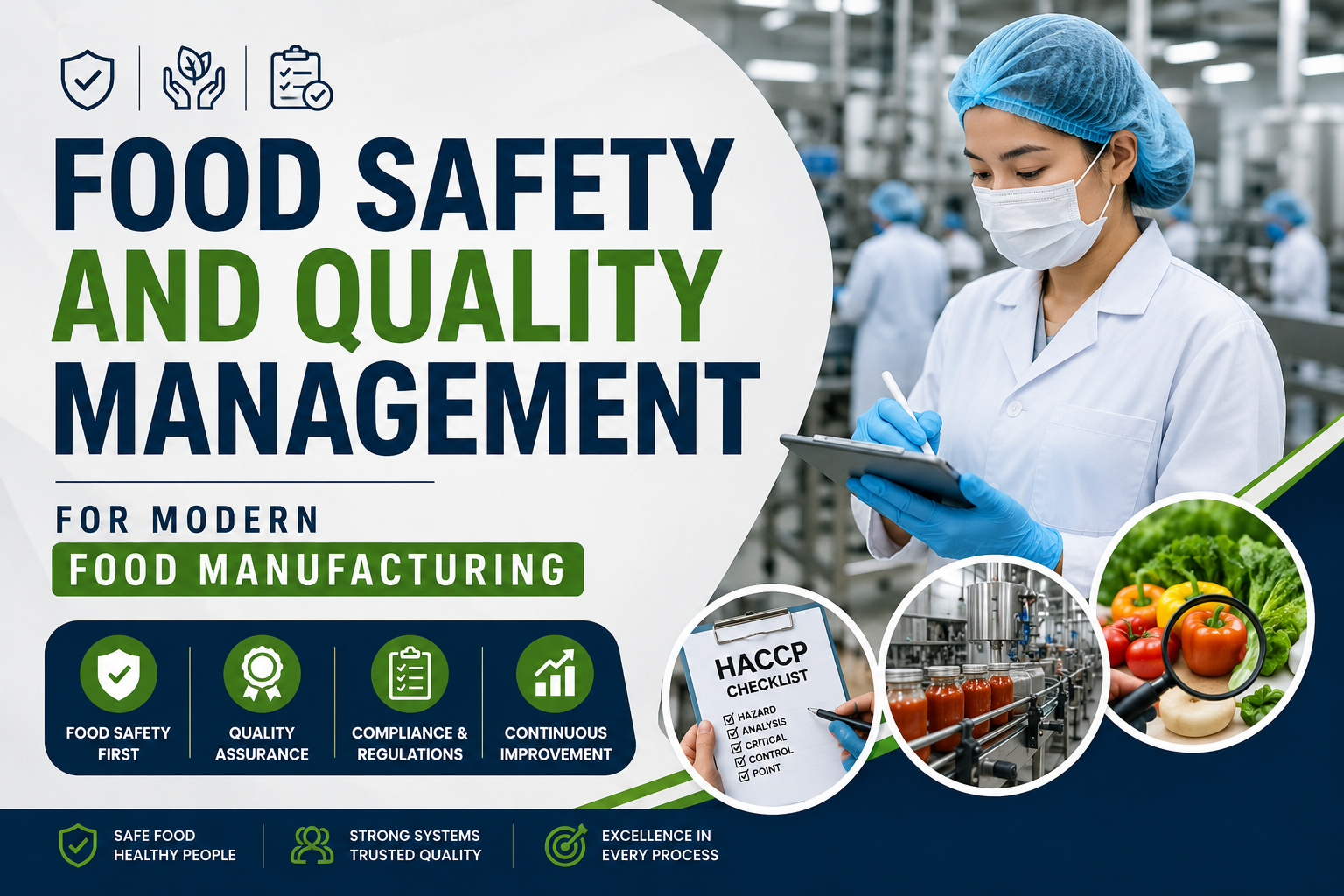
Food Safety and Quality Management for Modern Food Manufacturing

Trainer
About This Course
Overview
Food manufacturing operates in a highly regulated environment where safety, quality, and compliance decide whether a business succeeds. This course introduces the essential principles of food safety management, quality assurance, and the compliance frameworks used in modern production facilities.
What You Will Learn
- Good Manufacturing Practices (GMP) and HACCP principles
- ISO 22000 food safety management systems and audit preparation
- Food quality control techniques and regulatory compliance requirements
- Traceability, risk management, and digital quality monitoring
Who This Course is For
- Food production, QA, and QC personnel
- Production supervisors and factory managers
- Professionals responsible for compliance and audits
Conclusion
This course equips learners with practical knowledge to strengthen food safety, sustain compliance, and support operational excellence on the production floor.
FAQ
Check the frequently asked questions about this course.
Curriculum Overview
This course includes 5 sections, 18 lessons, and 7h 45m of material.
Learn the fundamental principles of food safety and quality management, including their importance in food manufacturing, consumer protection, regulatory compliance, and business sustainability.
A practical guide covering food safety principles, quality management systems, HACCP, GMP, ISO 22000, and best practices for maintaining safe and high-quality food products.
Test your understanding of food safety principles, quality management systems, food hazards, GMP, HACCP, and ISO 22000 requirements.
Learn about key food safety standards and regulatory frameworks including GMP, HACCP, ISO 22000, and national food regulations that govern modern food manufacturing operations.
A comprehensive guide covering GMP, HACCP, ISO 22000, regulatory requirements, compliance audits, documentation practices, and food safety management best practices.
An effective way to ensure a food business is meeting the food safety standards is by conduction food safety audits.
Food Safety audits provide insights about the organization’s food safety culture and practices and help to identify areas of improvement.
How to write an SOP? This is a guidance focused on learning about the elements or sections of a Standard Operating Procedure (SOP) and how to write them, in order to ensure consistency in daily operations and produce safe and quality products.
Evaluate your understanding of GMP, HACCP, ISO 22000, food regulations, compliance audits, and food safety management requirements.
Learn how quality assurance systems, quality control processes, and continuous improvement initiatives help food manufacturers maintain product consistency, meet customer expectations, and achieve operational excellence.
A practical guide covering quality assurance systems, quality control activities, non-conformance management, continuous improvement methodologies, root cause analysis, and quality performance monitoring.
Learn ALL about the 7 QC Tools while we work an example to demonstrate how you might use these tools in the real world. These include the Flow Chart, Check Sheet, Pareto Chart, Fishbone Diagram, Scatter Diagram, Histogram and the Control Charts
00:51 - Intro to the 7 QC Tools
1:33 – Flow Charts
3:59 – Check Sheets
5:32 – Pareto Charts
7:21 – The Cause-and-Effect Diagram (Fishbone Diagram)
10:19 – The Scatter Diagram (XY Scatter Plot)
12:36 – The Histogram
14:03 – The Control Chart
Test your understanding of quality assurance, quality control, continuous improvement, root cause analysis, and quality management practices in food manufacturing.
Learn how food manufacturers identify, assess, and manage food safety risks while implementing traceability systems that support product tracking, regulatory compliance, and effective recall management.
A practical guide covering food safety risk assessment, hazard management, traceability systems, recall procedures, and best practices for maintaining product integrity throughout the food supply chain.
This publication was funded by the European Union. Its contents are the sole responsibility of the NSF Euro Consultants Consortium and do not necessarily reflect the views of the European Union. (for compliance with Articles 14, 16, 18 & 19 of the General Food Law Regulation (EC) 178/2002)
By the end of this section, learners will be able to:
- Identify common food safety risks and hazards.
- Explain risk assessment and control processes.
- Understand traceability and recall management systems.
- Recognize technologies supporting food traceability.
- Apply risk management principles within food manufacturing operations.
Review the key concepts learned throughout the course and explore emerging trends that will shape the future of food safety, quality assurance, compliance, and food manufacturing operations.
Evaluate your understanding of food safety principles, regulatory compliance, quality assurance, continuous improvement, risk management, and traceability systems within food manufacturing environments.
Course Certificate
Course Specifications
Contact Us


Reply to Comment