



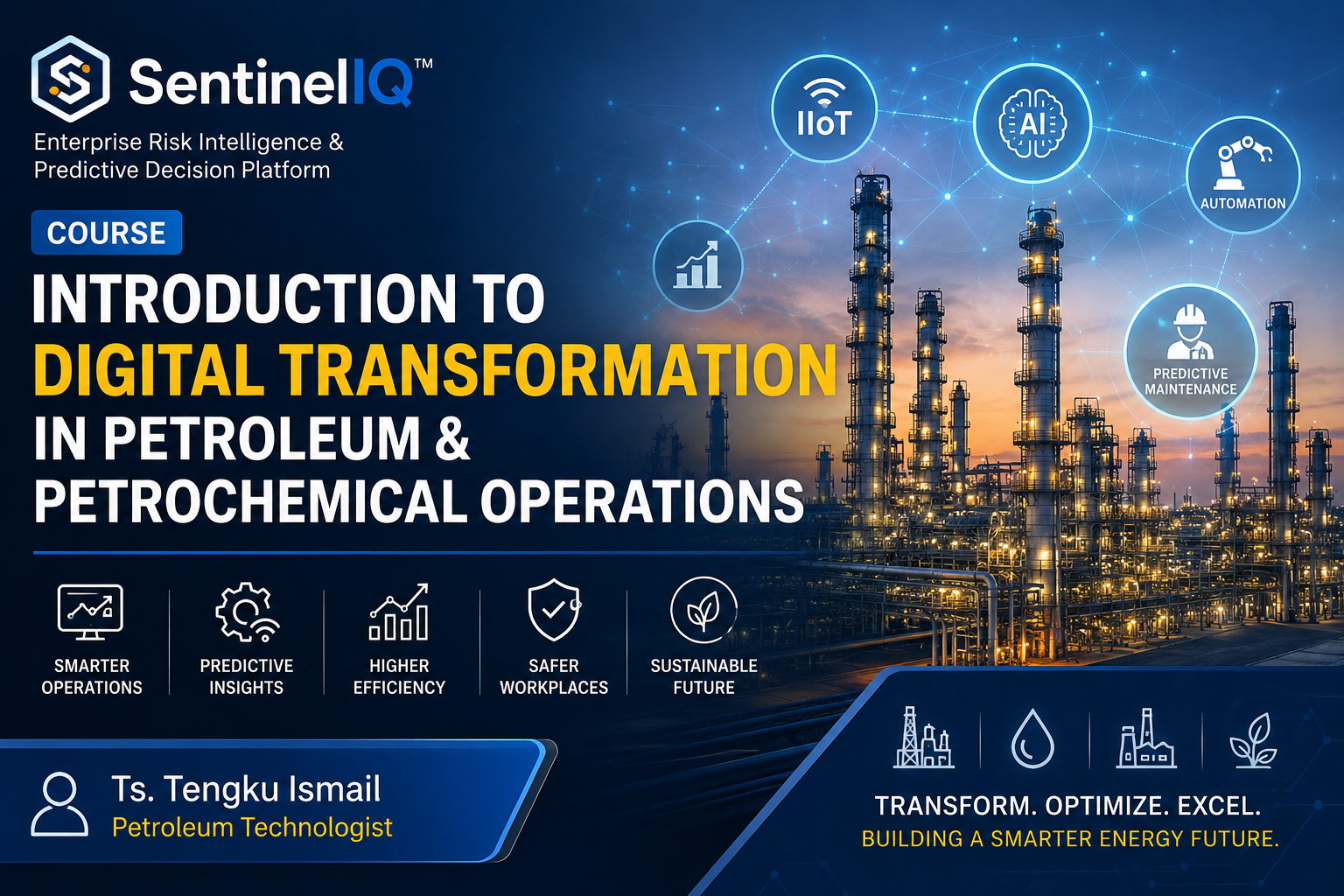
Introduction to Digital Transformation in Petroleum & Petrochemical Operations

About This Course
Overview
The petroleum and petrochemical industry is shifting rapidly towards digitalisation to raise productivity, reliability, and operational performance. This course introduces the fundamentals of digital transformation and how it is reshaping refinery, petrochemical, and industrial manufacturing operations.
What You Will Learn
- How AI, machine learning, and IIoT are applied across the petroleum value chain
- Predictive maintenance, smart manufacturing, and industrial automation
- The role of Industry 4.0 in data-driven decision-making and process safety
- How digital initiatives support energy efficiency, sustainability, and resilience
Who This Course is For
- Engineers, technologists, and operations personnel
- Plant managers and industry professionals
- Anyone supporting technology adoption in industrial operations
Conclusion
This course builds a solid foundation in digital transformation concepts, preparing learners to support technology initiatives within their own operations.
FAQ
Check the frequently asked questions about this course.
Curriculum Overview
This course includes 4 sections, 14 lessons, and 4h 50m of material.
Understand the concept of digital transformation and why it is becoming a strategic priority across the petroleum and petrochemical industry.
This guide introduces the key principles of digital transformation within petroleum and petrochemical operations. It explores how organizations are adopting digital technologies to improve operational efficiency, safety, reliability, and sustainability while preparing for Industry 4.0.
A thesis explaining how digital technologies are transforming petroleum and petrochemical facilities through smarter operations, improved decision-making, and enhanced operational performance.
Assess your understanding of the key concepts, technologies, benefits, and business drivers behind digital transformation in petroleum and petrochemical operations.
Learn how Industrial Internet of Things (IIoT) technologies enable real-time monitoring, asset visibility, predictive maintenance, and smarter decision-making across petroleum and petrochemical operations.
A practical guide explaining Industrial Internet of Things (IIoT) technologies, smart sensors, connected assets, real-time monitoring systems, and their applications in petroleum and petrochemical operations.
Guest: Mikhail Koloskov, Technology Manager, Digital Assets at IPCOS
Industry: oil & gas.
Business impact: edge analytics, remote monitoring.
The rise of the Industrial IOT means low-cost sensors are in harsh, remote locations collecting data that is critical to an overall real-time data infrastructure. Mikhail Koloskov, Technology Manager, Digital Assets at IPCOS, and Chris Felts, Senior Strategic Product Manager at OSIsoft, describe OSIsoft’s Edge Data Store and the critical role is plays in remote asset monitoring.
Evaluate your understanding of Industrial Internet of Things (IIoT) concepts, connected assets, real-time monitoring systems, and their role in improving petroleum operations.
Learn how predictive maintenance uses operational data, analytics, and artificial intelligence to detect potential equipment failures before they occur, improving reliability, safety, and operational efficiency.
A practical guide explaining predictive maintenance strategies, asset reliability principles, monitoring technologies, and real-world applications in petroleum and petrochemical operations.
Every device has a point of failure. What does that mean? Well, a new device fresh from the manufacturer is healthy and problem-free. Due to wear and tear on the device as it ages, its health slowly deteriorates and eventually it fails.
At this point, you need to perform maintenance for the device to get it back to a healthy condition. There are three main types of maintenance: Reactive, preventive, and predictive.
Assess your understanding of predictive maintenance concepts, asset monitoring technologies, reliability strategies, and their applications in petroleum operations.
Review the key concepts covered throughout the course and explore how emerging technologies will continue transforming petroleum and petrochemical operations in the future.
Evaluate your understanding of digital transformation, IIoT, predictive maintenance, Industry 4.0 technologies, and their applications within petroleum and petrochemical operations.
Course Certificate
Course Specifications
Contact Us


Reply to Comment