



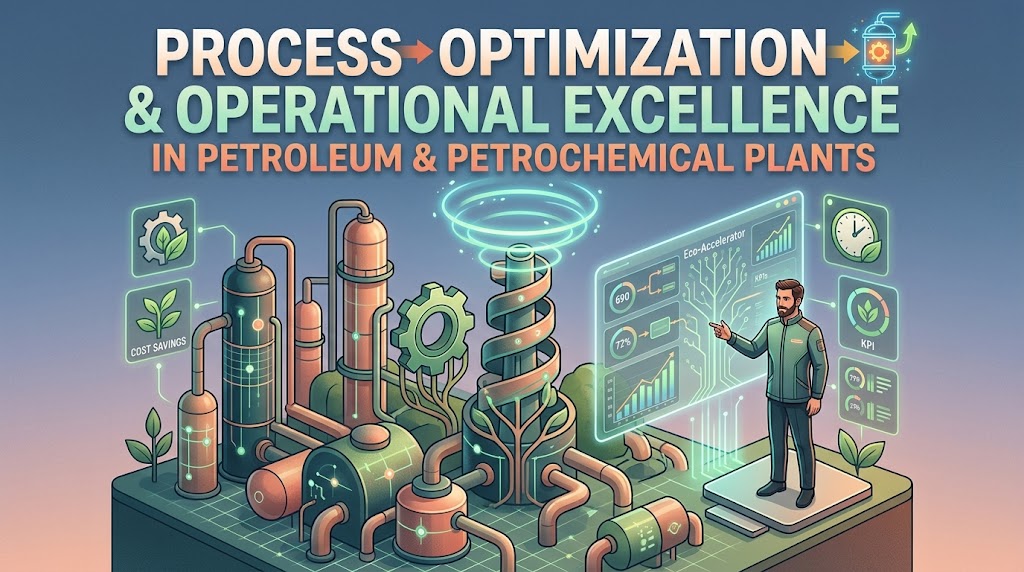
Process Optimization & Operational Excellence in Petroleum and Petrochemical Plants

Trainer (under Organization)
About This Course
Overview
In refineries and petrochemical plants, small inefficiencies compound quickly into lost production and cost. This course covers the process optimisation and operational excellence practices used to improve plant efficiency, reliability, and throughput.
What You Will Learn
- Fundamentals of refinery and petrochemical process optimisation
- Common sources of operational inefficiency, bottlenecks, and process constraints
- Evaluating process performance using operational data and KPIs
- Improvement techniques, equipment reliability links, and monitoring optimisation results
Who This Course is For
- Process, production, and plant engineers
- Operations supervisors and reliability personnel
- Professionals supporting continuous improvement in process plants
Conclusion
This course equips learners to identify where plant performance is being lost and to recommend practical, measurable process improvements.
FAQ
Check the frequently asked questions about this course.
Curriculum Overview
This course includes 3 sections, 12 lessons, and 6h 57m of material.
This lesson introduces the fundamentals of process optimization in petroleum, refinery, and petrochemical operations. Participants will learn how process optimization improves production efficiency, plant reliability, resource utilization, and operational performance while maintaining safety and product quality.
This practical worksheet helps participants assess an existing petroleum or petrochemical process, identify performance gaps, analyse possible causes, evaluate operating constraints, and propose suitable optimization actions while considering efficiency, reliability, quality, and safety.
Are you and your team currently utilizing the Process Improvement Mindset? If not, that could be a real problem for your processes!
In this video, we're defining what a Process Improvement Mindset is, how to implement it with your team, and discussing a real-life example of what this approach and mindset look like in a real small business. Then, we're going over three possible ways to respond to this scenario.
This quiz assesses participants’ understanding of process optimization fundamentals, performance variables, operational constraints, process control, efficiency, reliability, safety, and continuous improvement.
This lesson explains how refinery and petrochemical process performance is evaluated using production, efficiency, quality, reliability, and operating data. Participants will learn how to interpret key process indicators, identify performance gaps, understand the effect of operating conditions, and recognise factors that may reduce overall plant performance.
This practical worksheet helps participants evaluate refinery and petrochemical process performance by comparing actual operating results against target conditions. Participants will assess production, efficiency, product quality, equipment reliability, process stability, and downtime before identifying possible performance gaps and improvement actions.
The main scope of the course is to create strong basis and fundamentals regarding the processes in the Petroleum Refining. We take a look to the Oil&Gas Industry briefly and continue directly with the Refining Process. We then make a focus in each individual unit operation in the refinery.
Learn about:
- Oil& Gas Industry
- Difference between Petroleum Refining vs. Petrochemical Industry
- Overview of the most important operations and products
- Market insight (supply/demand) as well as (production/consumption)
- Several Petroleum Refineries around the World
Unit Operations & Processes
- Refining and Fractionation
- Atmospheric Distillation Column
- Vacuum Distillation
- Hydrotreating (Hydrogenation)
- Blending
- Reforming
- Isomerization
- Alkylation
- Steam Cracking
- Fluid Catalytic Cracking
- Gas Sweetening (Hydrodesulfurization)
- Coking
Components:
- Fuel Gas / Natural Gas
- Liquified Petroleum Gases (LPG)
- Propane, Butane
- Sulfur / Hydrogen Sulfide
- Gasoline / Automotive Gas Oil
- Naphtha Cuts (Light/Heavy)
- Kerosene
- Diesel
- Gasoil
- Lubricants
- Vacuum Residues
- Asphalt
- Coke
NOTE: This course is focused for Process Simulation
At the end of the course you will feel confident in the Petroleum Refining Industry. You will know the most common Process & Unit Operations as well as their distribution, production and importance in daily life.
This quiz assesses participants’ understanding of process performance, production efficiency, product quality, equipment reliability, operational stability, performance gaps, downtime, and performance monitoring
This lesson introduces the role of process monitoring and Key Performance Indicators (KPIs) in refinery and petrochemical operations. Participants will learn how to select meaningful KPIs, monitor operating conditions, identify performance deviations, and use trends and performance data to support operational decisions and continuous improvement.
This practical worksheet helps participants define suitable process KPIs, compare actual performance against targets, monitor trends, identify variances, and determine corrective actions. It also encourages participants to consider data reliability, KPI thresholds, review frequency, and ownership.
In this video, I'll show you how to make an interactive task management tracker in Excel. On the top of the Excel dashboard, we'll will show the KPIs, including tasks completed, tasks in progress, and tasks not started. We will also show the distribution of tasks by owner and employees and the number of tasks that are overdue. Below will show all of the different tasks, with formulas and conditional formatting to detect the task status, and which tasks are overdue. Throughout we'll be using Excel formulas like COUNTIF, SUM, or TODAY to make sure the file is dynamic. We'll also be using Excel tables, conditional formatting, drop-down lists, and much more to create a fully interactive task management tracker in Excel. Finally, for the KPIs, we'll be using bar charts, text boxes, and shapes.
This quiz assesses participants’ understanding of process monitoring, Key Performance Indicators (KPIs), targets, variances, leading and lagging indicators, performance trends, thresholds, and the use of operational data for continuous improvement.
Course Certificate
Course Specifications

Start and Master Your Skills!
Contact Us


Reply to Comment